Replies
No one has replied to this post.
Cheeky half hour for the masses, give the people what they want Steve. Interestingly.. curious if this is to be taken literally:
54. Unless the apprentice is on an alternative English apprenticeship, the provider must have evidence that the apprentice has an apprenticeship agreement with their employer, from the start of and for the actual duration of their apprenticeship
So if the actual end date is later than the planned end date, the agreement needs to be updated?
@... re the actual duration, I thought the same and actually made a note to find out whether we need to get an updated agreement if the learner goes past their end date.
p.s what is your YouTube channel Steve Hewitt I'd like to be one of the masses :-)
Oh, well, as you've asked so nicely ;)
https://www.youtube.com/@SteveHewittMIS/streams
#NotAnOfficialESFAWebinar
'Existing learners' would be (I am assuming) anyone who's apprenticeship has not finished, so live learners or those currently on a break.
As for learning being planned, are you asking about this generally, or in a specific circumstance e.g., following a gap in active learning? The rules are pretty clear in that it must be set out per the below, which includes what/how/when it will all be delivered. If something is missed, the expectation would be that the plan is updated to reflect the new 'schedule' of delivery:
82.5. Details of the training to be delivered:
82.5.1 For standards with a mandatory qualification this must be, as a minimum, a list of the units, along with a description of any additional activities that the apprentice will undertake to develop occupational competency.
82.5.2 For standards without a mandatory qualification this must be a description of the activities that the apprentice will undertake to develop occupational competency.
82.5.3 It must be clear if the training has been included in the planned off-the-job training hours.
82.5.4 The training plan must not include any content that has been identified and agreed with the employer, as relevant prior learning (see paragraphs 24 to 25).
82.6. Details of when content will be delivered.
82.7. Details of who is responsible for each component of delivery.
82.7.1 This may include the provider, a subcontractor or the employer. Where this party is accessing apprenticeship funding for the delivery, they must be on the Register of Apprenticeship Training Providers (unless the exemption at paragraph 183.3 applies).

If there's a gap in the training plan of at least a calendar month, then a break will be required. As a crude example, if a learners plan had module 1 scheduled for May-Jun, then module 2 set for Aug-Oct.. you've got a clear month (July) where no learning has been planned, in which case you'd need to apply a break in learning for that month.
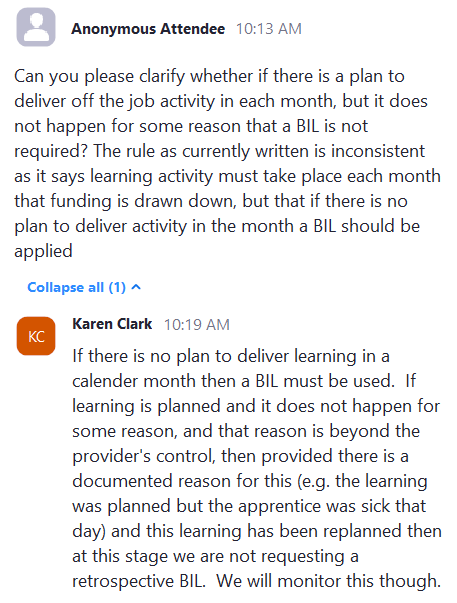
No, that's permitted under the guidance.
75.5. If planned off-the-job training is unable to take place as scheduled in any calendar month, a retrospective break in learning is not required as long as there is active learning in the following calendar month. The provider must ensure that all missed activity is re-planned and delivered, so that the full content of the training plan can still be delivered.
They did say at the AELP webinar Steve mentioned that they would be monitoring this practice though, so I certainly would try not to make a habit of it where possible and/or without good cause.
On the basis that 75.1 clarifies that 75 applies to existing learners, I think by extension this would include 75.5
75.1. This rule change (from every 4 weeks to every calendar month) applies to new starts and to existing learners on programme on 31 July 2023.
That's my assumption anyway haha, prepared to be corrected!
Question regarding Funding Rule 20.4 To access funds in the employer’s apprenticeship service account or government-employer co-investment, the provider must ensure that the individual :
Is able to complete the apprenticeship within the time they have available, including the end-point assessment. If the provider knows an individual is unable to complete the apprenticeship in the time they have available, (e.g., because their visa will expire or because they have a fixed term contract which is shorter than the duration of the apprenticeship), they must not be funded.
In regards to applicants who have a British Residence Permit (BRP), and this is due to expire prior to the end of the apprenticeship programme, are they not eligible?
Where apprenticeship programme duration is for 3+ years (such as degree apprenticeships) this will rule out a lot of applicants, as their visa will expire prior to the end date of the apprenticeship, however their intention would be to reapply for a new / extended visa.
I would expect to confirm the applicants intentions, however this seems to discount these individuals completely?
This seems to disadvantage a considerable number of applicants?
Ugh, can't believe they've made it *worse*...
Still think 290/291 takes precedence for these learners?
290. Any individual, or relevant family member, who has applied for an extension or
variation of their current immigration permission in the UK is still treated as if
they have that leave. Keeping this permission applies as long as the application
was made before their current permission expired. Their leave continues until
the Home Office make a decision on their immigration application.
291. An individual, or relevant family member, is considered to still have the
immigration permission that they held when they made their application for an
extension. Their eligibility would be based upon this status
But will chase...
Another Question for clarification

Does the above mean that including apprentice's on Part-time or zero hour contracts that:
- the planned duration has to be extended in-line with the funding rule requirements, however, if they are ready to achieve ahead of the new minimum planned duration for the hours worked, but after 12 months and the minimum OTJ hours for the actual time has been met then they can complete their apprenticeship training?
example -
original start date 01/09/2023
Extended duration due to part-time hours - 01/12/2024
completes all learning by 10/09/2024 - this is acceptable (as long as OTJ hours have been met also)?
Thanks
Hi everyone,
Please could I get a bit of advise and clarity on this section below for additional learning support -
29. As part of the initial assessment (which is an eligible cost), the provider must
undertake a screening exercise for learning support.
Which screening tests does this mean? We have a number at college however is it something more specific they are looking for?
1. Query about visas has been escalated to the technical team (am not holding breath)
2. Karen Fone I think (think) that if you had a normal programme that was 18 months and then extended it for (to keep the maths simple) someone on 15 hours a week, so it was 36 months, then that learner's "legal" minimum would be 24 months??? But you're right, this para makes it look like 12 months (so what's the point in extending if they can do all the OTJ?). You'd still have to do all the "completing early" stuff.
3. Hannah Riley I think the minimum screening is a tick box asking if they have any disabilities or learning difficulties, rather than anything more involved?
Hannah Riley just to add a little to Steve's advice re. the screening exercise, I had actually raised a ticket with the ESFA when the rules first came out where I asked if including the typical questions on the eligibility/application form would satisfy this requirement, and they said:
What you have described can be seen as a first step screening exercise as you are putting the emphasis on the learner to help identify any disabilities or difficulties they might have and based on this initial step you will then take relevant steps. Also as you would do a skills scan/initial assessment you could constitute this as screening and based on your assessment you might identify difficulties a learner has without them being aware they had said difficulties.
Ben James
23/24 Funding Rules - Version 1
Created
Apprenticeship funding rules 2023 to 2024 (publishing.service.gov.uk)
Apprenticeship funding rules 2023 to 2024: summary of changes (publishing.service.gov.uk)
Happy days: